The Heterogeneous Impacts COVID-19 Pandemic on Global Scientific Collaboration
This project was collaborated with Jianghao Wang and Xiaofan Liang
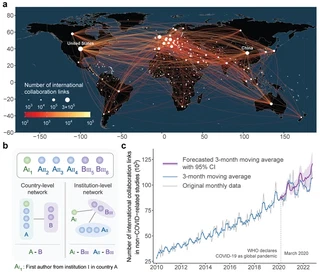
Abstract Scientific collaboration catalyzes knowledge diffusion and breeds innovation. However, the COVID-19 pandemic has disrupted the rhythm of research cooperation. To track the dynamics and key drivers of scientific collaboration after the COVID-19 outbreak, we analyzed a scientific collaboration network from 25.2 million publications worldwide from 2010 to 2022. We found that the volume of non-COVID-related international collaboration declined 22.2% by late 2022 compared to the pre-pandemic growth trend, with greater impacts on social science, large teams, and top schools. Comparatively, COVID-related international collaboration increased by 179.7%. The scholar-level analysis revealed that researchers developed fewer new collaborators, shifted their research interests to COVID-related topics, and junior academics were more affected. Despite remarkable changes, the impact of the pandemic on international collaborations is less conspicuous than on domestic collaborations. Our findings suggest that funders and institutes should balance rapid funding for disciplines and scientists being most disrupted to recover from the pandemic.

I am a PhD graduate at the WorldPop, University of Southampton. My research focuses on how environmental and policy changes shape human behaviours and population health, bridging geospatial data sciences, computational social science, econometrics, and public health.
My current work focuses on three themes: 1) Spatiotemporal population dynamics, mapping monthly, daily, to hourly population distribution by integrating mobile phone positioning and geospatial data. 2) Human behaviours and disease dynamics, drawing on social media and digital traces data to examine how human mobility and health behaviours shape infectious disease transmission, and how health interventions affect mental well-being. 3) Human mobility and climate change, which investigates the impacts of climate and environmental exposure, including floods, tropical cyclones, and wildfires, on human mobility and population health.