What Digital Mobile Health Systems Add to Infectious Disease Control? A Modelling Study
This project is led by Zhifeng Cheng, Chu He, and Shengjie Lai. We greatly appreciate the Jiangsu Centre for Disease Control and Prevention (CDC) for developing and operating the mHealth system, and for sharing the data.
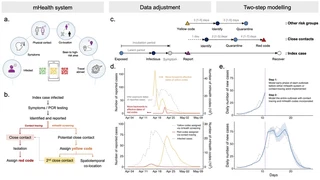
Abstract Digital health tools, including mobile device location-based health (mHealth) applications, have been adopted to augment conventional contact tracing during recent epidemics and pandemics, yet quantitative evidence about their added epidemiological value remains limited. Using aggregated, privacy-preserving mHealth data from six Chinese cities (July 2021 - May 2022), we modelled transmission dynamics of emerging respiratory infections to quantify the heterogeneous effects of mHealth-triggered movement restrictions and risk-based quarantines across viral variants. We found that the mHealth-assisted interventions, together with population-wide lockdowns, could rapidly reduce the effective infection rate and drive daily incidence toward zero within two weeks, which was rarely achieved through traditional contact tracing alone. Scenario simulations further showed that in the absence of mHealth interventions, infections consistently propagated to connected cities across a wide range of epidemiological assumptions, contradicting the reality. These results suggest that early integration of geolocated mHealth tools with traditional epidemiological investigations enhances outbreak containment at both local and regional scales, providing quantitative, spatially explicit evidence to inform scalable mHealth integration strategies for future infectious threats with pandemic potential.

I am a PhD graduate at the WorldPop, University of Southampton. My research focuses on how environmental and policy changes shape human behaviours and population health, bridging geospatial data sciences, computational social science, econometrics, and public health.
My current work focuses on three themes: 1) Spatiotemporal population dynamics, mapping monthly, daily, to hourly population distribution by integrating mobile phone positioning and geospatial data. 2) Human behaviours and disease dynamics, drawing on social media and digital traces data to examine how human mobility and health behaviours shape infectious disease transmission, and how health interventions affect mental well-being. 3) Human mobility and climate change, which investigates the impacts of climate and environmental exposure, including floods, tropical cyclones, and wildfires, on human mobility and population health.