Individuals’ Self-Disclosure on Social Media Reveals Sentiment and Mental Well-Being Benefits of Vaccination
This project was collaborated with Jianghao Wang, Yichun Fan, and Siqi Zheng
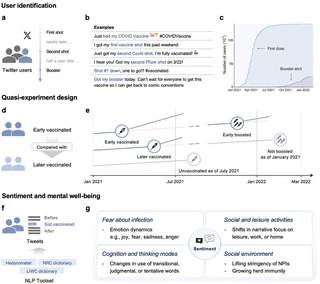
Abstract Vaccination prevents not only the transmission of pathogens but also the adverse psychological effects of epidemics. Prior knowledge of the mental well-being benefits of vaccination relies on cross-sectional surveys, which are limited in scale, subject to self-report bias, and could be confounded by hidden differences across individuals. Here, we collected 154,348 Americans who self-declared receiving the COVID-19 vaccine on Twitter (now called X) and implemented a staggered quasi-experiment design to analyze their 160 million tweet activities, teasing out the causal effect of vaccination on changes in expressed sentiment and mental well-being. We found that being fully vaccinated is associated with an increase in sentiments of 0.055 (95% CI 0.037 to 0.072) standard deviations at the individual level. The effects are stronger among males, adolescents, Hispanic and Asian Americans, and individuals who have experienced severe local epidemics. Investigation of underlying mechanisms suggests that fully vaccinated individuals experience fewer negative emotions, engage in more leisure activities, and are less likely to grapple with conflicting thoughts. Additionally, a more relaxed social environment from lifted lockdowns and increasing herd immunity positively correlates with sentiment improvement. Our study provides a new approach to assessing the impact of medical treatment on mental health by mining large-scale self-reported social media data.

I am a PhD graduate at the WorldPop, University of Southampton. My research focuses on how environmental and policy changes shape human behaviours and population health, bridging geospatial data sciences, computational social science, econometrics, and public health.
My current work focuses on three themes: 1) Spatiotemporal population dynamics, mapping monthly, daily, to hourly population distribution by integrating mobile phone positioning and geospatial data. 2) Human behaviours and disease dynamics, drawing on social media and digital traces data to examine how human mobility and health behaviours shape infectious disease transmission, and how health interventions affect mental well-being. 3) Human mobility and climate change, which investigates the impacts of climate and environmental exposure, including floods, tropical cyclones, and wildfires, on human mobility and population health.