Unravelling Dual Roles of Human Activity in Shaping Global Fire Regimes
This project is leading by Jianghao Wang and Zhiyi Zhang
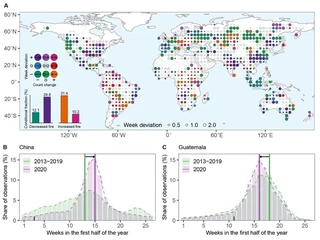
Abstract Understanding the intertwined impacts of climate change and human activities on global fire regimes is critical, yet current evidence remains limited in distinguishing the specific roles of humans in driving or mitigating fire occurrences. This study addresses this gap by leveraging the unprecedented global reductions in human activity during the COVID-19 pandemic as a natural experiment. By comparing global fire occurrences in the first half of 2020 with their usual levels, we estimate the contributions of reduced human activity to shifts in fire patterns using a weekly dataset at 0.5° spatial resolution, derived from satellite observations of fires and complemented by meteorological data, pandemic-related restrictions on human mobility and activities. Our analysis reveals that reduced human activity led to an average global decline of 11.8% in fire incidence, with remarkable spatial heterogeneity indicating the dominant human roles in either igniting or controlling fires. Notably, fire occurrences in forests and areas with lower anthropogenic modifications experienced the most substantial declines, highlighting the varying sensitivity of ecosystems to human activity. These findings underscore the critical influence of human activity on fire regimes, suggesting that integrated fire management strategies incorporating frequency, intensity and characteristic of human behavior are essential for mitigating wildfire risks in vulnerable regions.

I am a PhD graduate at the WorldPop, University of Southampton. My research focuses on how environmental and policy changes shape human behaviours and population health, bridging geospatial data sciences, computational social science, econometrics, and public health.
My current work focuses on three themes: 1) Spatiotemporal population dynamics, mapping monthly, daily, to hourly population distribution by integrating mobile phone positioning and geospatial data. 2) Human behaviours and disease dynamics, drawing on social media and digital traces data to examine how human mobility and health behaviours shape infectious disease transmission, and how health interventions affect mental well-being. 3) Human mobility and climate change, which investigates the impacts of climate and environmental exposure, including floods, tropical cyclones, and wildfires, on human mobility and population health.