How Multi-Hazard Early-Warning Systems Benefit Mobility Resilience to Tropical Cyclones
This project was led by Haiyan Liu and Jianghao Wang.
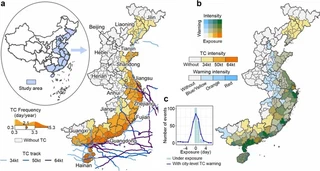
Abstract Multi-hazard early-warning systems (MHEWS) are critical for mitigating extreme weather impacts and enhancing disaster resilience. However, quantitative empirical evidence on how different types of early warnings individually and collectively trigger preventive actions and influence resilience remains limited. Here, using location-based human mobility data aggregated from over 1.1 billion mobile devices across Chinese cities, we quantified daily intracity human mobility responses to 21,126 early warning signals during 19 tropical cyclones (TCs) from 2021 to 2023. To represent disaster resilience under MHEWS protection, we developed a protected resilience index that integrates both the magnitude of mobility changes and recovery durations. We found that, compared with city-level TC warnings alone, combined multi-level, multi-hazard warnings resulted in a 52.4 % reduction in mobility during TC exposure days, thereby increasing avoided direct population exposure by around 57.1 %. Each additional warning type further shortened recovery times, collectively reducing recovery durations by at least 55.6 %, with larger effects observed for stronger TCs. Under MHEWS protection, protected resilience remained statistically similar between moderate-intensity TCs (34 kt and 50 kt) but declined significantly under severe (≥64 kt) conditions. Although absolute reductions in exposure were greater in high-frequency, coastal, and wealthier cities, relative improvements from MHEWS were more pronounced in less frequently affected, inland, and socioeconomically disadvantaged areas. Consequently, MHEWS significantly narrowed resilience disparities among cities facing equivalent hazard exposures. This study introduces a scalable, behaviour-based framework for quantifying early-warning effectiveness, highlighting the essential role of integrated multi-level and multi-hazard warnings in disaster preparedness across cities amid escalating climate risks.

I am a PhD graduate at the WorldPop, University of Southampton. My research focuses on how environmental and policy changes shape human behaviours and population health, bridging geospatial data sciences, computational social science, econometrics, and public health.
My current work focuses on three themes: 1) Spatiotemporal population dynamics, mapping monthly, daily, to hourly population distribution by integrating mobile phone positioning and geospatial data. 2) Human behaviours and disease dynamics, drawing on social media and digital traces data to examine how human mobility and health behaviours shape infectious disease transmission, and how health interventions affect mental well-being. 3) Human mobility and climate change, which investigates the impacts of climate and environmental exposure, including floods, tropical cyclones, and wildfires, on human mobility and population health.